
/tcs/uploads/categories/20260106-09-59-00_2452a0ee-5d2f-4f0a-ad18-1d653e48926a.jpg)
/tcs/uploads/categories/20260106-09-24-54_fa149ae6-6b92-41a2-8c58-6872c3f98f46.jpg)
/tcs/uploads/categories/20260420-14-42-55_6x4-pent-2.jpeg)
/tcs/uploads/categories/cycle-storage-cycle-lockers.jpeg)
/tcs/uploads/categories/20260420-14-39-09_parkis-5.jpg)
/tcs/uploads/categories/20260106-09-51-52_img-1458.jpg)
/tcs/uploads/categories/cycle-storage-bike-pump-repair-stands.jpeg)
/tcs/uploads/categories/20260420-14-44-33_whatsapp-image-2026-02-24-at-131821-4.jpeg)
Secure Cycle Storage for Transport Hubs: Meeting the Growing Demand for Bike-and-Ride in the UK
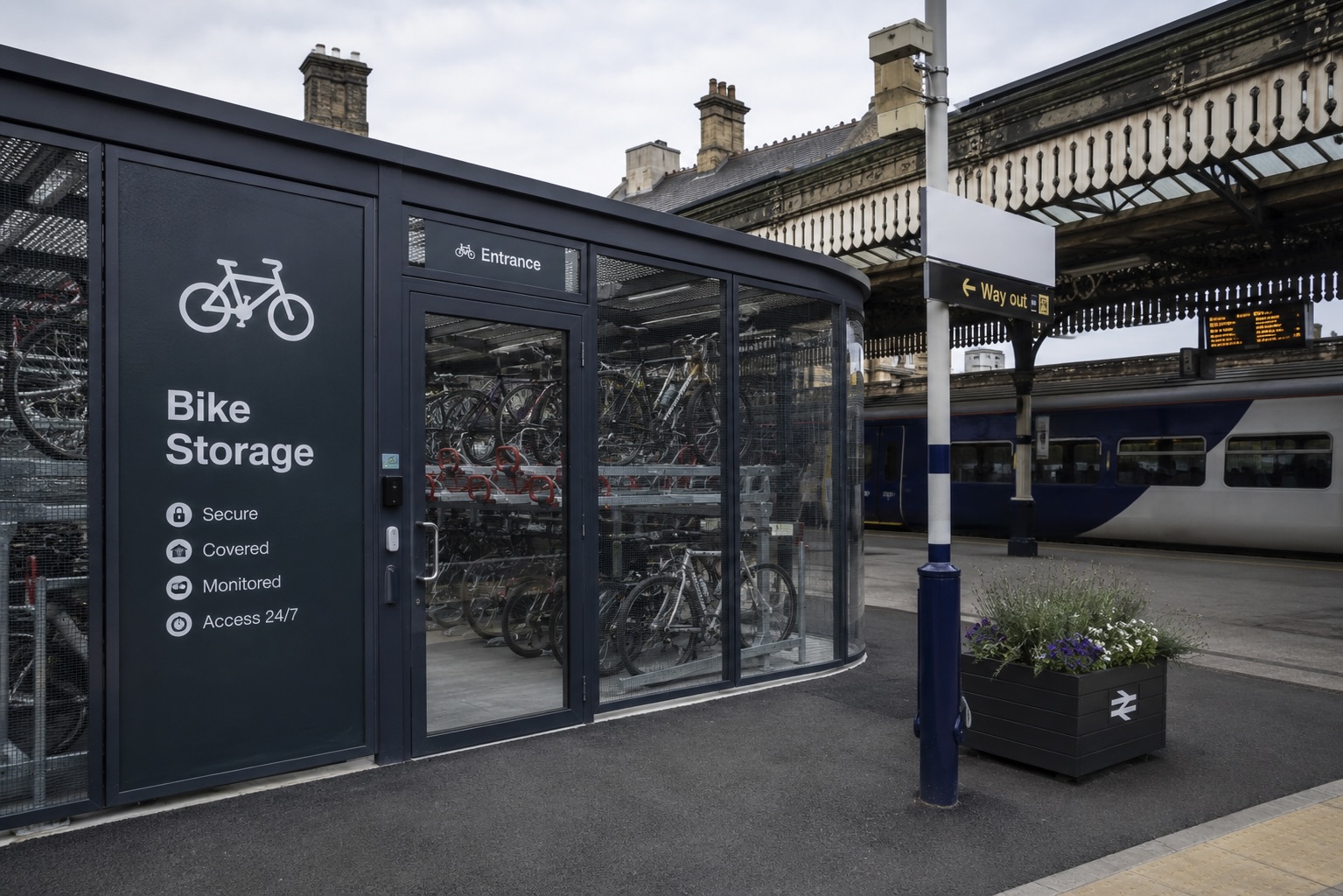
Transport hubs including train stations, bus interchanges, and airports across the UK need high-capacity, secure cycle storage to meet rising bike-and-ride demand and comply with Active Travel England standards. Rail operators, local authorities, and transport planners face growing pressure to provide safe, compliant cycle parking that supports multimodal journeys and station travel plans.
Why Transport Hubs Need Dedicated Cycle Storage Now
Bike-and-ride is one of the fastest ways to grow public transport patronage, and secure, well-located cycle parking is the critical enabler. Active Travel England guidance states that transport hubs should be “at the heart of local walking and cycling networks,” with cycle hubs identified as the most appropriate form of cycle parking at public transport stations Active Travel England Transport Hubs Guidance. Yet many UK stations and interchanges remain under-equipped, creating barriers to multimodal journeys.
The gap between demand and provision is widening. British Transport Police recorded 4,106 bicycle thefts from UK railway stations in 2024 UK Bike Theft Statistics 2025. Of the 4,193 bikes stolen from stations that year, only 22 suspects were formally charged, a charge rate of less than 0.5% road.cc. Insecure or poorly located parking directly deters commuters who cannot risk losing their primary transport mode. The UK cycling modal share sits at just 2% Cycling UK Statistics, and improving the security and capacity of transport hub cycle parking is one of the highest-impact interventions available to increase that figure.
What Active Travel England and LTN 1/20 Require for Transport Hubs
Active Travel England requires that transport hubs provide secure cycle parking integrated with other facilities including accessible toilets, changing rooms, and lockers for secure storage Active Travel England Transport Hubs Guidance. Cycle hubs, which are indoor, staffed or CCTV-monitored facilities offering maintenance, hire, lockers, and changing space, are the recommended standard for stations and interchanges. For smaller, unstaffed railway stations and bus stops, covered cycle parking with good natural surveillance and CCTV coverage is the minimum acceptable provision.
The Department for Transport’s LTN 1/20 guidance under Chapter 11 sets out cycle parking standards including the requirement that at least 5% of all spaces accommodate non-standard cycles such as cargo bikes and adapted cycles UK Government LTN 1/20. Section 11.6 of the same guidance specifically addresses connectivity between cycling and other modes, emphasising the need for seamless interchange at transport hubs.
Station travel plans are now a mandatory requirement for DfT-funded station improvements, and secure cycle parking provision is a central compliance criterion. The Cycle Rail scheme, delivered in partnership with the Rail Delivery Group, has already created around 22,000 new cycle parking spaces at UK stations, with a further 2,367 spaces planned in the next funding round Rail Delivery Group Station Funding Toolkit. Despite this progress, the overall gap between supply and demand remains significant at major commuter stations.
The Key Design Challenges for Transport Hub Cycle Storage
Space Constraints in High-Traffic Concourses
Transport hubs operate at high density, and floor space is at a premium. Two-tier cycle racks are the default solution for concourse areas because they use roughly half the floor area of traditional Sheffield stands (Secure Cycle Store product specification). For a 50-bike installation, this represents a saving of approximately 25 square metres of concourse space. However, LTN 1/20 requires that non-standard cycle spaces including cargo bikes and e-bikes be accommodated in ground-level, accessible positions, meaning a mixed provision strategy is essential.
Security and Theft Prevention
The scale of cycle theft at UK stations demands a robust security response. With nearly 70,000 bikes reported stolen in London alone between March 2021 and February 2025 Evening Standard, and the British Transport Police recording over 4,100 thefts from stations nationally in 2024, secure, monitored parking is no longer optional. Active Travel England recommends that cycle parking at transport hubs be located where there is good natural or active surveillance and covered by CCTV Active Travel England Transport Hubs Guidance. Cycle hubs with controlled access, CCTV monitoring, and individual locker options provide the highest level of security assurance.
Accommodating E-Bikes and Cargo Cycles
E-bikes accounted for 11.36% of all bicycles sold in the UK in 2024, up from just 0.86% in 2015 Pauls Cycles UK E-Bike Statistics. The UK e-bike market is expected to reach 165,000 units in 2025, a 13% increase from the previous year Bicycle Association. Standard two-tier racks cannot accommodate heavy e-bikes on the upper tier, and cargo bikes require ground-level spaces with wider access. Transport hub cycle storage must therefore include designated e-bike and cargo spaces with adequate width, weight capacity, and charging provision.
“Designing for all cycle types is the single most common oversight we see in transport hub projects,” says Ashley Prescott, Managing Director of Secure Cycle Store. “Operators plan for standard commuter bikes and forget that e-bikes are heavier, cargo bikes are wider, and adapted cycles need ground-level access. A compliant hub has to accommodate all of them from day one.”
Weather Protection and Maintenance
Transport hubs operate 24 hours a day, 365 days a year. Exposed cycle parking with inadequate drainage or poor-quality finishes leads to accelerated corrosion, reduced usage, and increased maintenance costs. Weatherproof Bike Shelters with powder-coated steel construction, anti-graffiti finishes, and integrated drainage are the minimum specification for transport hub installations. Cycle hubs should also include Public Bike Repair Stands and e-bike charging points as standard amenities.
Multimodal Integration and Last-Mile Connectivity
Cycle parking at transport hubs exists to enable multimodal journeys, not as an end in itself. Effective integration includes clear wayfinding from cycle parking to platforms, level-access routes, and real-time journey information at the cycle hub. Mobility hubs, which combine cycle parking with shared e-bikes, scooter hire, parcel lockers, and digital information pillars, represent the emerging standard for multimodal integration. The CoMoUK Mobility Hubs Guidance (2019/20) identifies secure cycle parking as a core component of mobility hub design, alongside covered waiting areas and improved public realm.
Recommended Solutions for Transport Hub Cycle Storage
Two-Tier Bike Racks for High-Density Concourse Parking
Two-Tier Bike Racks provide the highest density of any cycle parking solution, accommodating up to 100 bikes in the floor area that would otherwise hold 50 Sheffield stands. Gas-assisted mechanisms make the upper tier accessible to most users, and the lower tier can accommodate e-bikes up to 25kg. These are the standard solution for rail station concourses and indoor cycle hubs.
Secure Bike Lockers for Overnight and Long-Stay Parking
Bike Lockers offer individual, lockable storage that provides the highest level of theft protection. They are particularly suited to airport long-stay parking, overnight train station storage, and locations where users leave bikes for extended periods. E-bike-compatible lockers with internal power points are available for charging.
Cycle Hubs for Comprehensive Multimodal Facilities
A cycle hub is an enclosed, monitored facility providing 50 to 200 bike spaces alongside repair stands, lockers, changing facilities, and e-bike charging. They represent the gold standard for major transport interchanges and mobility hubs. Active Travel England specifically identifies cycle hubs as the most appropriate form of cycle parking at public transport stations Active Travel England Transport Hubs Guidance.
Cycle Shelters for Intermediate and Smaller Stations
Weatherproof Bike Shelters in modular designs accommodate 10 to 50 bikes and are suitable for unstaffed stations, bus interchanges, and smaller transport hubs. CCTV-ready designs, integrated lighting, and anti-graffiti finishes ensure long-term durability in exposed locations.
Repair Stands and E-Bike Charging
Multimodal transport hubs should include Public Bike Repair Stands and e-bike charging stations as standard rider amenities. These facilities increase the usability of cycle parking and support the growing proportion of e-bike users in the commuting population.
Comparison of Cycle Storage Solutions for Transport Hubs
| Feature | Two-Tier Rack | Bike Locker | Cycle Hub | Cycle Shelter |
|---|---|---|---|---|
| Floor space per bike | 375mm | 2m+ | 500mm | 600mm |
| Daily capacity | 50 to 100+ bikes | 1 per locker | 50 to 200 bikes | 10 to 50 bikes |
| E-bike capacity | Lower tier only | Yes | Yes | Yes |
| CCTV-ready | No | Optional | Yes | Optional |
| Weather protection | Covered required | Full | Full | Partial |
| Best for | High-density concourse | Long-stay/overnight | Major interchanges | Smaller stations |
Supporting Details: Compliance, Funding, and Maintenance
Compliance Pathways
Transport hub cycle parking must comply with LTN 1/20, the Equalities Act 2010 (for accessible spaces), and relevant BREEAM credits if the hub is part of a new development. BREEAM Tra 03 and Tra 04 credits for transport hubs require secure cycle parking provision aligned with occupancy levels, alongside shower and changing facilities BREEAM UK. Station Travel Plans, required for DfT funding, must include a cycle parking strategy.
Funding Opportunities
In December 2025, the UK government announced £626 million in multi-year funding for walking, wheeling, and cycling schemes through Active Travel England Active Travel England. This funding, covering the period 2026/27 to 2029/30, is sufficient to deliver 500 miles of new and upgraded active travel routes and support 170,000 additional active trips per day. Local authorities can bid for transport hub improvements as part of their consolidated active travel allocations. Nine councils improved their ATE capability rating in 2025, with higher-rated authorities receiving greater proportions of capital funding.
The Cycle Rail scheme continues to fund new cycle parking at stations, with 22,000 spaces already delivered and further rounds in progress. Private sector transport operators can also invest in cycle parking as part of franchise commitments and station improvement programmes.
Maintenance and Inspection
High-traffic transport hub cycle parking requires regular inspection and maintenance. Moving parts on two-tier racks, locking mechanisms on lockers, and lighting and CCTV systems all require scheduled servicing. Anti-graffiti and anti-corrosion finishes reduce long-term maintenance costs. (Secure Cycle Store site survey data 2025-2026)
When Transport Hub Cycle Storage Is Right for Your Site
Transport hub cycle storage is the right solution for train stations of all sizes, bus interchanges and termini, airport long-stay and staff parking, mobility hubs combining multiple transport modes, and park-and-ride sites with cycle integration. It is less suitable for low-volume rural stops with fewer than 50 daily passengers, where simple Cycle Stands may provide adequate provision, and for temporary or pop-up hubs where modular, relocatable solutions are more cost-effective.
Frequently Asked Questions
How many cycle parking spaces does a transport hub need?
There is no single national standard, but LTN 1/20 recommends approximately one cycle space per five peak commuter arrivals at major hubs. Station Travel Plans typically set site-specific targets based on demand modelling, existing provision, and projected growth in bike-and-ride mode share. A typical commuter station serving 5,000 daily passengers should plan for a minimum of 200 to 300 cycle spaces Active Travel England.
Can two-tier bike racks accommodate e-bikes?
Standard two-tier racks can accommodate e-bikes weighing up to 20 to 25kg on the lower tier only. For heavier e-bikes or cargo bikes, ground-level spaces and wider access aisles are required. Secure Cycle Store offers a Gas Assist Two-Tier Rack rated to 25kg and compatible with most commuter e-bikes.
What security features should transport hub cycle parking include?
Active Travel England recommends CCTV monitoring, good natural or active surveillance, controlled access, and secure locking points on all cycle stands. Cycle hubs with individual lockers and access control provide the highest security level. Given that over 4,000 bikes were stolen from UK stations in 2024, security investment is essential to protect users and maintain modal shift momentum UK Bike Theft Statistics 2025.
What is the difference between a cycle hub and a cycle shelter?
A cycle hub is an enclosed, monitored facility with controlled access that provides indoor cycle parking alongside additional amenities such as maintenance stations, lockers, changing facilities, and e-bike charging. A cycle shelter is a covered, open-access structure that provides weather protection without the additional facilities or security controls. Active Travel England identifies cycle hubs as the most appropriate form of cycle parking at major public transport stations Active Travel England Transport Hubs Guidance.
How can I fund cycle parking for my station or transport hub?
Funding is available through Active Travel England’s Consolidated Active Travel Fund, the Cycle Rail scheme delivered with the Rail Delivery Group, local authority active travel budgets, and private sector investment through franchise commitments or station improvement programmes. The December 2025 ATE funding announcement allocated £626 million for active travel infrastructure covering 2026/27 to 2029/30, with transport hub cycle parking eligible for inclusion in local authority bids Active Travel England.
Do transport hub cycle parking spaces need to accommodate cargo bikes and adapted cycles?
Yes. LTN 1/20 requires that at least 5% of all cycle parking spaces accommodate non-standard cycles including cargo bikes, adapted cycles, and tandems. These spaces must be at ground level, wider than standard spaces, and positioned in the most accessible locations UK Government LTN 1/20.
Get Compliant Cycle Storage for Your Transport Hub
Secure Cycle Store designs, supplies, and installs cycle parking solutions for transport hubs across the UK. From two-tier racks and secure lockers to full cycle hub fit-outs, we handle compliance with LTN 1/20, Active Travel England requirements, and station travel plans. Get a Quote at securecyclestore.com/get-a-quote/ or call +44 (0)151 933 8895.
Last updated: 2026-05-06. Updated with current ATE funding allocations, LTN 1/20 compliance requirements, and product specifications.


